
Keyword
monsoon
31 record(s)
Type of resources
Available actions
Topics
Keywords
Contact for the resource
Provided by
Representation types
Update frequencies
Status
-
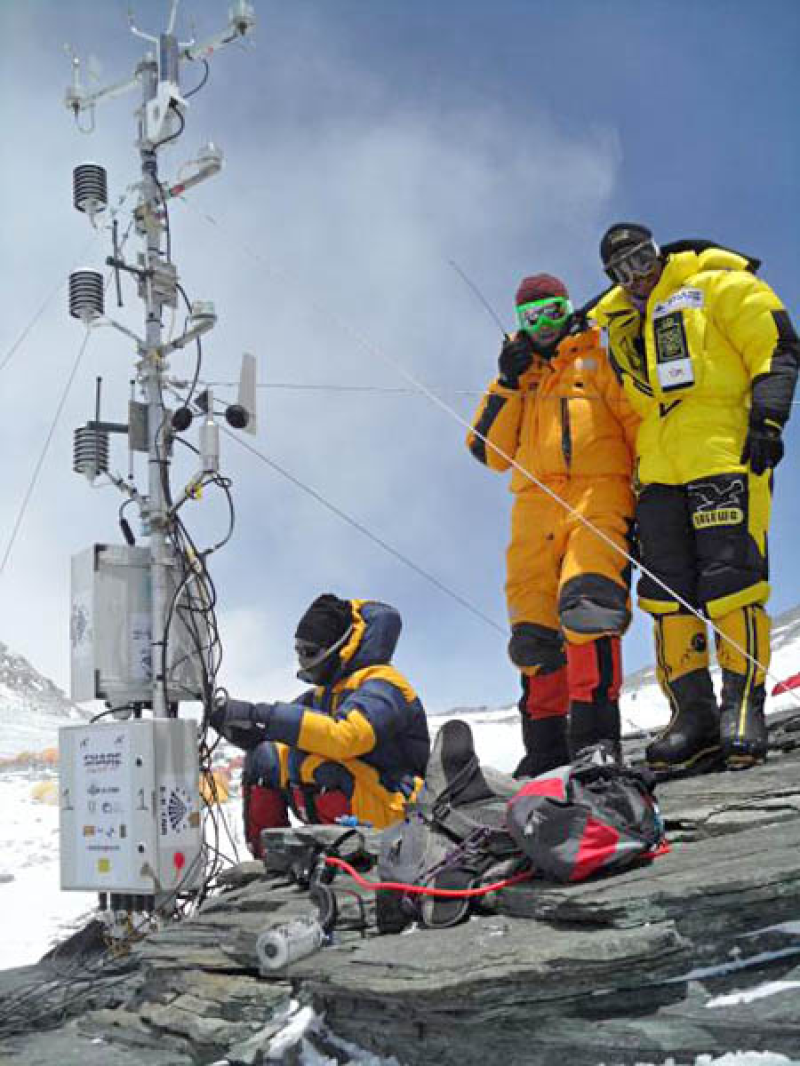
In the Khumbu Valley, located in the central part of the Himalayan range and including the area of Sagarmatha National Park, a network of 7 Automatic Weather Station (AWSs) has been installed since 1994. These weather stations are located at different altitudes: Lukla (2,660 m a.s.l), Namche (3,570 m a.s.l), Periche (4,260 m a.s.l), Lobuche (5,050 m a.s.l) near the Pyramid Laboratory - Observatory, Kala Patthar (5,600 m a.s.l), Changri Nup Glacier (5,700 m a.s.l) and Mt. Everest - South Col (8.000 m a.s.l). The network mainly takes measurements of 7 standards parameters: air temperature, relative humidity, atmospheric pressure, wind speed and direction, global radiation and total precipitation. After a test period during summer 2008, the South Col AWS station has been re-installed on May 2011. The South Col station is equipped with technologically-advanced sensors for measuring temperature, humidity, wind speed and direction, atmospheric pressure and solar radiation. Support, energy and data transmission systems are optimized for functioning in adverse weather conditions. South Col AWS observations can provide useful information for investigating: (i) the variability of the subtropical jet stream analysis, (ii) the summer monsoon onset and decay, (iii) the stratospheric intrusion events, (iv) the occurrence of severe weather conditions on Mt. Everest. Geographical coordinates: - Latitude: 27° 58' N - Longitude: 86° 56' E
-

The Vaisala WXT520 multi-parameter weather transmitter installed at Nepal Climate Observatory -Pyramid is a compact and lightweight multi-sensor instrument that measures the most essential weather parameters. The meteorological parameters measured are air temperature, atmospheric pressure, relative humidity, wind speed and direction, precipitation.
-

Both in 2008 and in 2011 expedition a DPA 007, manufactured by LSI-Lastem was installed at South Col. This broad band radiometers measure electromagnetic radiation intensity in a determined interval of wavelength. Applications often need information about emission in ultraviolet, infrared, and visible spectral band, demanding a more specialized instrumentation.
-

Meteorological data were acquired directly at the NCO-P site using the Vaisala WXT510 weather transmitter.
-

During the 2011 expedition, a prototype replaces the sensor installed during 2008 expedition. A prototype (LSI-Lastem) to support with other two sensors manufactured by VAISALA: WMT700 and WA15D7B. The WA15 is based on accurate sensors installed on a large crossarm. It is designed for demanding wind measurement applications.
-

During the 2011 expedition, a prototype replaces the sensor installed during 2008 expedition. A prototype (LSI-Lastem) to support with other two sensors manufactured by VAISALA: WMT700 and WA15D7B. The WA15 is based on accurate sensors installed on a large crossarm. It is designed for demanding wind measurement applications.
-

Both in 2008 and in 2011 expedition a CM6B Kipp&Zonen radiometer was installed at South Col. The radiometer measures the energy balance between incoming short-wave and long-wave IR radiation versus surface-reflected short-wave and outgoing long-wave IR radiation.
-

In this framework SHARE Everest 2008 project has been carried out and on May 15, 2008 the highest Automatic Weather Station (AWS) of the world has been installed at Mt. Everest South Col, (8,000 m a.s.l.). The AWS guarantee continuous measurements of air temperature, relative humidity, atmospheric pressure, global solar radiation, UVA radiation, wind speed and direction. The parameters are recorded every ten minutes and data are transmitted hourly to a server at the Pyramid Laboratory-Observatory (5,050 m a.s.l., near Lobuche in Nepal’s Khumbu Valley), and from there to Ev-K2-CNR headquarters in Italy. After a test period during summer 2008, the South Col AWS station has been re-installed on May 2011. The South Col station is equipped with technologically-advanced sensors for measuring temperature, humidity, wind speed and direction, atmospheric pressure and solar radiation. Support, energy and data transmission systems are optimized for functioning in adverse weather conditions. South Col AWS observations can provide useful information for investigating: (i) the variability of the subtropical jet stream analysis, (ii) the summer monsoon onset and decay, (iii) the stratospheric intrusion events, (iv) the occurrence of severe weather conditions on Mt. Everest.
-

In 2008 expedition, at South Col was installed the DMA572 termohygrometer, that was replaced during the 2011 expedition with two DMA672 termohygrometers and one DMA033 thermometer. All these sensors are manufactered by LSI-Lastem (Italy). DMA 672 thermohygrometer is an instrument for measuring temperature and relative humidity and suitable for a continuous measurement in severe environments; in presence of deep thermal and hygrometric ranges with high sun radiant heat.
-

In 2008 at South Col the CombiSD DNA022 sensor (LSI-Lastem, Italy) was installed. During the 2011 expedition, this sensor was replaced with a prototype (LSI-Lastem) to support with other two sensors manufactured by VAISALA: WMT700 and WA15D7B. The CombiSD combines sensors for measuring both wind speed and direction in a single instrument.