
Type
collectionHardware
17 record(s)
Type of resources
Available actions
Topics
Keywords
Contact for the resource
Provided by
Years
Formats
Representation types
Update frequencies
Scale
-
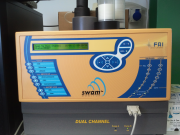
Monte Curcio (MCU) instruments: Fai SWAM Dual Particulate Matter Sampler. The SWAM is a dual channel sampler for particulate matter, and a mass measurement technique. The system combines field-proven beta attenuation analysis with dual-channel sequential sampling yielding simultaneously PM10, PM2.5 and total mass concentration.
-
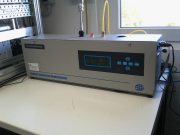
Monte Curcio (MCU) instruments: Ecotech Aurora 3000 Nephelometer. The Model Aurora 3000 measures continuously and in real-time, light scattering (the scattering coefficient σsp) in a sample of ambient air due to the presence of particulate matter at three wavelengths (450 Blue, 525 Green and 635 Red). These measurements are combined with backscatter measurements that only sample 90° - 170°, therefore allowing a more in depth analysis of particle scattering. Forward scatter are calculated from subtracting backscatter from total scatter. The measured values are adjusted automatically and in real-time by on-board temperature and pressure sensors.
-
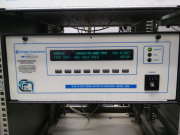
Monte Curcio (MCU) instruments: API Teledyne 300E carbon monoxide analyser. The Model 300E uses a method based on the Beer-Lambert law, an empirical relationship that relates the absorption of light to the properties of the material through which the light is travelling over a defined distance. In this case the light is infrared radiation (IR) travelling through a sample chamber filled with gas bearing a varying concentration of CO.
-
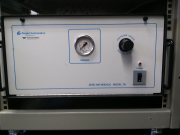
Monte Curcio (MCU) instruments: API Teledyne 701 zero air generator. The Model 701 is a source of clean, dry air for dilution calibrators. It also may be used as a source of purge air for permeation tube ovens or burner air for FID analysers. The regenerative, heatless dryer removes water and produces gas with a dewpoint of less than -20°C (up to 15 SLPM flow rate) independent of the inlet dewpoint and assists in the removal of other gases, greatly increasing the life of the chemical scrubbers. The basic M701 includes an oil and diaphragm free pump plus scrubbers to remove SO2, NO, NO2, O3 and H2S. Optional high performance scrubbers are available to remove CO and Hydrocarbons. Inlet air is pulled into the pump and routed through a pre-cooler and water trap to remove moisture.
-
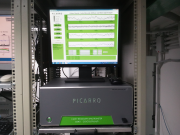
Monte Curcio (MCU) instruments: Picarro G2401 methane, carbon monoxide, carbon dioxide and water analyser. The Model G2401 is based on cavity ring-down spectroscopy (CRDS), capable of measuring the concentrations e compounds. This technique enables measurement of absolute optical extinction by samples that scatter and absorb light. A laser is used to illuminate a high-finesse optical cavity, which consists of two highly reflective mirrors. When the laser is in resonance with a cavity mode, intensity builds up in the cavity due to constructive interference. The laser is then turned off in order to allow the measurement of the exponentially decaying light intensity leaking from the cavity. During this decay, light is reflected back and forth thousands of times between the mirrors giving an effective path length for the extinction on the order of a few kilometres.
-
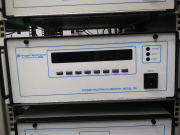
Monte Curcio (MCU) instruments: API Teledyne 700 mass flow calibrator. The Model M700 can generate diluted calibration gas including ozone, gas phase titration (NO2) from gas cylinders, or from a permeation tube source gas. Each concentration is generated precisely by mixing the gas with diluent zero air in which the mixing ratio is controlled by the mass flow controller. The diluent air mass flow controller has a range of 10 SLPM (20 SLPM option), and the gas mass flow controller has a range of 100 cc/min. (0-50 cc/min., 0-200cc/min. options). The mass flow controllers assure a precise mixing ratio for accurate and precise calibration gas generation using the state-of- the-art electronic closed-loop control.
-
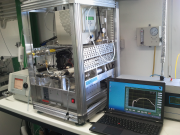
Monte Curcio (MCU) instruments: TSI Scanning Mobility Particle Sizer (SMPS). The Model SMPS is designed for long-term measurement of aerosol particles and over there in highly burden regions. It is a mobility particle size spectrometer, which can measure continuously the particle number size distribution in a size range from 10 to 800 Nanometres. The temporal resolution to measure a complete particle number size distribution is approximately 5 minutes. Equipment is based on TSI CPC 3775.
-
Monte Curcio (MCU) instruments: API Teledyne 100E sulphur dioxide analyser. The Model 100E is an analyser that determines the concentration of sulphur dioxide (SO2) in a sample gas drawn through the instrument’s sample chamber where it is exposed to ultraviolet light causing any SO2 present to fluoresce.
-
Monte Curcio (MCU) instruments: Fai Hydra Dual Particulate Matter Sampler. The Hydra is a dual channel sampler for particulate matter collected on filters that are analysed in laboratory. The sampler is used to detect elemental (EC) and organic carbon (OC) on quartz filters by thermo-optical analysis. The analytical procedure allows the determination of each individual component. The Hydra mounts one sampling head for PM10 and one for PM2.5
-
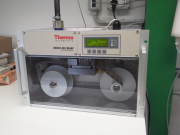
Monte Curcio (MCU) instruments: Thermo Scientific Multiangle Absorption Photometer (MAAP). The MAAP 5012 measures black carbon content of aerosols determined by simultaneous measurement of optical absorption and scattering of light by the particles collected on the glass fiber tape. The minimum detection limit are: 2 min. average less than 100ng/m3; 10 min. average less than 50ng/m3; 30 min. average less than 100ng/m3.