
Keyword
italy
26 record(s)
Type of resources
Available actions
Topics
Keywords
Contact for the resource
Provided by
Representation types
Update frequencies
Status
-
Geographical Coordinates: - Latitude: 39° 25' N - Longitude: 16° 12' E The basin Bonis (39 ° 25'15 '' N and 16 ° 12'38 '') is located in the Sila Cosenza and is a sub-basin of the river Cino. It has an area of 139 hectares. The basin , public property , was identified and designed from 1984 and equipped in 1986 with the aim of establishing a permanent laboratory for the study of the water balance at the basin level and water processes at the scale of slopes ( sub-basins ) , in forest stands ( Corsican pine ) , also in relation to the evolutionary dynamics leading to thinning operations . The monitoring of the outflows was carried out with the realization, in the closing section , of a building of measurement consists of a stilling reinforced concrete . The stretch of river bed upstream of the tank is channeled to a length of 32 meters and in the end parts extends in the shape of a funnel to link up with a bridle in cement concrete on the one hand and with the tank on the other side . From the point of view of forest cover the surface is affected by the 80% of populations of Corsican pine (Pinus laricio Poiret ) , largely man-made , made in the period between 1955 and 1970. The nuclei of natural origin , age next to that of reforestation , occupy the highest part of the pelvis in the left and right bank . Within the basin , in May 2003 , in the village Cozzarella - Don Bruno , a tower was installed to measure the mass exchange (CO2 , H2O) and energy (sensible heat , H) between forest and atmosphere that makes use the eddy covariance technique . The tower is the site of forest further south in Italy and has the objective to study the dynamics of carbon exchange and evapotranspiration of a reforestation of Corsican pine . The decision to install the measuring station for the exchange of CO2 and water vapor in this basin was made to adopt an integrated measure of the hydrosphere - biosphere - atmosphere interactions . The station was installed in an artificial pine forest about 35 years old, planted on former pasture and sparse in 1986 , which represents the main ecosystem of the basin , and a principal of the Calabria region .. The morphology is slightly wavy . The geological substrate is composed of granitic rocks , the soils belong to the association Ultic Haploxeralfs , characterized by a clayey horizon with illuvial clay focused, often , even in the strip ( Dimase & Iovino 1996 Castrignanò & Buttafuoco 2004). From the point of view phytoclimatic the area is due to the hot sub Fagetum ( Pavari 1916) On the phytosociological , the pine forest is attributable to the association Hypochoerido - Pinetum laricionis , which can implant in areas uncovered by forming consortia which is generally quite sparse . The pine forest has 637 trees per hectare, basal area of 45.4 m2 ha-1 , mean diameter of 29 cm and average height of 21.5 m , the leaf area index , measured with the LAI -2000 ( LiCor , Lincoln , Nebraska - USA ) was of 6.6 ± 0:18 m2 m -2. At this site are active , since June 2003, micrometeorological measurements and instrumentation to measure the exchange of carbon and water vapor.
-
The TROPOS-SMPS is designed for long-term measurement of aerosol particles and over there in highly burden regions. It is a mobility particle size spectrometer, which can measure continuously the particle number size distribution in a size range from 10 to 800 Nanometers. The temporal resolution to measure a complete particle number size distribution is approximately 5 minutes. Measured data are stored on a PC or notebook, which is part of the measuring system. The current particle number size distribution is displayed graphically as part of the data acquisition and control software. The instrument comprises a condensation particle counter and a radioactive source (Ni-63).
-
Geographical CoordinatesCCC: - Latitude: 40° 20' 8.79" N - Longitude: 18° 7' 29.12" E The CNR-ISAC station in Lecce is located about 4 km (SW) of the urban area and it can be classified as an “urban background” site. The site is located at about 30 km and 80 km from the most important industrial centres of the Puglia Region (Taranto and Brindisi). The observatory is accommodated in a shelter located on the roof of the Institute of Atmospheric Sciences and Climate (Division of Lecce), at about 12 m above the street, inside the University Campus. The observatory is used for the collection of environmental continuous data related to local meteorology, various gaseous pollutants concentration and different atmospheric particulate fraction. The instrumental check, the data acquisition and data analysis are remotely managed through internet. The roof of the shelter is equipped to take real-time meteorological measurements using a radiometer (Kipp & Zonen, mod. CNR4), that measures solar and thermic radiation, and an automatic wheatear station (Vaisala, mod. WXT520) for the main meteorological parameters acquisition. On the roof of the observatory there are sampling probes for gas and aerosol connected to the measurement instruments located inside the shelter. Outside the observatory there is a booth, which hosts the mixtures of pure gases needed for periodic calibration of gas concentration detectors and a telescopic mast to measure particle number concentration and vertical particle fluxes, using the Eddy-Covariance method by an Ultrafine Condensation Particle Counter UCPC (TSI, mod. 3776) and an ultrasonic anemometer Gill R3. The interior of the shelter is equipped with different instruments for atmospheric and environmental measurements: The roof of the shelter is equipped to take real-time meteorological measurements using a radiometer (Kipp & Zonen, mod. CNR4), that measures solar and thermic radiation, and an automatic wheatear station (Vaisala, mod. WXT520) for the main meteorological parameters acquisition (Figure Le-2 b). On the roof of the observatory there are sampling probes for gas and aerosol connected to the measurement instruments located inside the shelter. Outside the observatory there is a booth (Figure LE-02 d), which hosts the mixtures of pure gases needed for periodic calibration of gas concentration detectors and a telescopic mast to measure particle number concentration and vertical particle fluxes, using the Eddy-Covariance method (Figure LE-02 a) by an Ultrafine Condensation Particle Counter UCPC (TSI, mod. 3776) and an ultrasonic anemometer Gill R3. The interior of the shelter is equipped with different instruments for atmospheric and environmental measurements (Figure Le-2 e): Heated gas sampling probe (General Impianti srl) with conditioning of temperature to control relative humidity, connected to a 11 valves manifold. Aerosol sampling probe, PM10 cut-off, with 10 valves manifold equipped with a high volume pump (Mega System srl, mod. X1-Hornet). Measurements of particle size distribution in the following intervals: • from 8 nm to 800 nm: Scanning Mobility Particle Sizer (SMPS produced by the Tropos- Leibniz Institute for Tropospheric Research, in compliance with Actris specifications). • from 0.28 µm to 10 µm: Optical Particle Counter (OPC FAI instruments, mod. Multichannel). Particulate sampler (FAI Instruments, mod. SWAM5a Dual Channel) which measures the PM2.5 and PM10 mass concentrations using the measuring principle based on attenuation of β ray. Measurements of Black Carbon concentrations in atmosphere by a Multi Angle Absorption Photometer (Thermoscientific, mod. 5012). Measure of atmospheric aerosol back scattering coefficient by a Nephelometer (TSI, mod. 3560). Measurements of gaseous concentrations, CO, CO2, CH4 and water vapour, by a detector PICARRO (mod. G2401). Measurements of gaseous concentrations by an ozone automatic analysers (Thermoscientific, mod. 49i) and a nitrogen oxides analysers (Thermoscientific, mod. 42i-TL). Measurements of the columnar content of gaseous pollutants by a spectrophotometer DOAS which is provided with an external measuring head (located on the observatory roof) connected to the spectrophotometer by optics fibres. Calibration systems for gas detectors: Multipoint calibrator (Thermoscientific, mod. 146i) used for the nitrogen oxides calibration, ozone generator (Thermoscientific, mod. 49i-PS) for the ozone concentration analyser and zero air generation (Thermoscientific, mod. 146i). A server station with monitor that communicates with the various instruments and stores the data. The server station operates as a vehicle for the display and the remote data transfer. It is connected to a data logger Campbell Scientific CR1000 with a buffer battery.
-
SWAM 5a Dual Channel Monitor è un sistema di campionamento automatico sequenziale di materiale particellare su membrane filtranti che opera con due linee di prelievo indipendenti. La misura di massa dei due campioni prelevati è effettuata contestualmente grazie alla metodologia dell’attenuazione b, che permette di raggiungere un’incertezza sul dato di misura di massa dell’ordine di 10 μg. SWAM 5a Dual Channel Monitor consente quindi di monitorare contemporaneamente, con elevato standard qualitativo, l’evoluzione temporale delle concentrazioni di massa di due frazioni di materiale particellare PM10 e PM2,5. La disponibilità dei campioni accumulati su membrane filtranti ne permette inoltre la caratterizzazione chimica.
-
Geographical CoordinatesCCC: - Latitude: 40° 20' 8.79" N - Longitude: 18° 7' 29.12" E The CNR-ISAC station in Lecce is located about 4 km (SW) of the urban area and it can be classified as an “urban background” site. The site is located at about 30 km and 80 km from the most important industrial centres of the Puglia Region (Taranto and Brindisi). The observatory is accommodated in a shelter located on the roof of the Institute of Atmospheric Sciences and Climate (Division of Lecce), at about 12 m above the street, inside the University Campus. The observatory is used for the collection of environmental continuous data related to local meteorology, various gaseous pollutants concentration and different atmospheric particulate fraction. The instrumental check, the data acquisition and data analysis are remotely managed through internet. The roof of the shelter is equipped to take real-time meteorological measurements using a radiometer (Kipp & Zonen, mod. CNR4), that measures solar and thermic radiation, and an automatic wheatear station (Vaisala, mod. WXT520) for the main meteorological parameters acquisition. On the roof of the observatory there are sampling probes for gas and aerosol connected to the measurement instruments located inside the shelter. Outside the observatory there is a booth, which hosts the mixtures of pure gases needed for periodic calibration of gas concentration detectors and a telescopic mast to measure particle number concentration and vertical particle fluxes, using the Eddy-Covariance method by an Ultrafine Condensation Particle Counter UCPC (TSI, mod. 3776) and an ultrasonic anemometer Gill R3. The interior of the shelter is equipped with different instruments for atmospheric and environmental measurements: The roof of the shelter is equipped to take real-time meteorological measurements using a radiometer (Kipp & Zonen, mod. CNR4), that measures solar and thermic radiation, and an automatic wheatear station (Vaisala, mod. WXT520) for the main meteorological parameters acquisition (Figure Le-2 b). On the roof of the observatory there are sampling probes for gas and aerosol connected to the measurement instruments located inside the shelter. Outside the observatory there is a booth (Figure LE-02 d), which hosts the mixtures of pure gases needed for periodic calibration of gas concentration detectors and a telescopic mast to measure particle number concentration and vertical particle fluxes, using the Eddy-Covariance method (Figure LE-02 a) by an Ultrafine Condensation Particle Counter UCPC (TSI, mod. 3776) and an ultrasonic anemometer Gill R3. The interior of the shelter is equipped with different instruments for atmospheric and environmental measurements (Figure Le-2 e): Heated gas sampling probe (General Impianti srl) with conditioning of temperature to control relative humidity, connected to a 11 valves manifold. Aerosol sampling probe, PM10 cut-off, with 10 valves manifold equipped with a high volume pump (Mega System srl, mod. X1-Hornet). Measurements of particle size distribution in the following intervals: • from 8 nm to 800 nm: Scanning Mobility Particle Sizer (SMPS produced by the Tropos- Leibniz Institute for Tropospheric Research, in compliance with Actris specifications). • from 0.28 µm to 10 µm: Optical Particle Counter (OPC FAI instruments, mod. Multichannel). Particulate sampler (FAI Instruments, mod. SWAM5a Dual Channel) which measures the PM2.5 and PM10 mass concentrations using the measuring principle based on attenuation of β ray. Measurements of Black Carbon concentrations in atmosphere by a Multi Angle Absorption Photometer (Thermoscientific, mod. 5012). Measure of atmospheric aerosol back scattering coefficient by a Nephelometer (TSI, mod. 3560). Measurements of gaseous concentrations, CO, CO2, CH4 and water vapour, by a detector PICARRO (mod. G2401). Measurements of gaseous concentrations by an ozone automatic analysers (Thermoscientific, mod. 49i) and a nitrogen oxides analysers (Thermoscientific, mod. 42i-TL). Measurements of the columnar content of gaseous pollutants by a spectrophotometer DOAS which is provided with an external measuring head (located on the observatory roof) connected to the spectrophotometer by optics fibres. Calibration systems for gas detectors: Multipoint calibrator (Thermoscientific, mod. 146i) used for the nitrogen oxides calibration, ozone generator (Thermoscientific, mod. 49i-PS) for the ozone concentration analyser and zero air generation (Thermoscientific, mod. 146i). A server station with monitor that communicates with the various instruments and stores the data. The server station operates as a vehicle for the display and the remote data transfer. It is connected to a data logger Campbell Scientific CR1000 with a buffer battery.
-
OPC MULTICHANNEL MONITOR è un contaparticelle ottico multicanale per la caratterizzazione in tempo reale della distribuzione granulometrica del materiale particellare aerodisperso nel range granulometrico interessato dai modi di accumulazione di massa “fine” e “coarse”. Tale caratterizzazione avviene fornendo sia la concentrazione in numero di particelle per ogni intervallo granulometrico in cui è suddiviso il campo di misura, sia fornendo dati di concentrazione di massa delle frazioni PM10.
-
The Model 5012 Multi Angle Absorption Photometer (MAAP) black carbon monitor measures ambient and source black carbon (BC) concentrations and aerosol light absorption properties. It is based on the principle of aerosol-related light absorption and the corresponding atmospheric black carbon (BC) mass concentration. It uses a multi angle absorption photometer to analyze the modification of radiation fields in the forward and back hemisphere of a glass-fiber filter caused by deposited particles. The data inversion algorithm is based on a radiation transfer method and therefore takes multiple scattering processes inside the deposited aerosol and between the aerosol layer and the filter matrix explicitly into account.
-
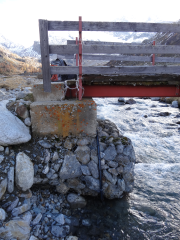
Place: Val Viola, near Federico hut Country: Italy Position latitude 46,41941 N longitude 10,19727 E elevation 2126 m.a.s.l. Datalogger Lastem E-log Sensor piezometric sensor Sensotek, 4-20 mA, 12V Power supply solar panel 5W + battery Pb 12V 5 Ah Installation date 26-07-09 Watershed area [km2] 17,12
-

The resource describes the field activities for hydrological activities held in 2011, 2012 and 2013 in the area of Braldo Valley. The network of sampling points in this valley is composed by: Brd01 Korophon Brd02 Bardumal Brd03 Paiju camp Brd04 Baltoro Brd05 Paiju bridge Brd06 Golibital Brd07 Askole Brd08 Shigar bridge Brd09 Khoburtse Brd10 Urdukas Brd11 Jola Brd12 Bardumal, Braldo river Brd13 Jula camp Brd14 Shigar restaurant Brd15 Dasso Brd09 Khoburtse Brd16 Liligo Brd17 Biafo bridge Brd19 Lomar Spang, Tistong (tank) Brd20 Tistong (tap1) Brd21 Chukhil, Dassu Brd22 Sarfloss, Dassu Brd23 Glacier before Khoburtse Brd24 Baltoro glacier's right Brd25 Askole (tank)
-
The resource describes the field activities for hydrological activities held in 2011, 2012 and 2013 in the area of Basha Valley. The network of sampling points in this valley is composed by: Bsh01 Chumik Arindo Bsh02 Togi Arindo Bsh03 Khargan Arindo Bsh04 Bisil Bombari Bsh05 Bisil Skilkor Bsh06 Zill Shkong Bsh07 Zill Malong Bsh08 Seisko Shuaika Bsh09 Seisko Biarzing Bsh10 Chotrong Khonjing Bsh11 Tisal Bsh12 Tisal Bsh13 Starga Khor /thorgo) Bsh14 Tutsa Bein Bsh15 Bein (man source) Bsh16 Bein (lowest point) Bsh17 Dogoro Gone (thank) Bsh18 Dogoro Iul (thank) Bsh19 Dogoro Hango Tap 1 Bsh20 Basha river(dogoro) Bsh21 Hamisil Tank Bsh22 Hamisil Tap