
Keyword
CHEMISTRY, SUBSTANCES, PROCESSES
19 record(s)
Type of resources
Available actions
Topics
Keywords
Contact for the resource
Provided by
Years
Formats
Representation types
Update frequencies
Scale
-
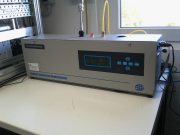
Monte Curcio (MCU) instruments: Ecotech Aurora 3000 Nephelometer. The Model Aurora 3000 measures continuously and in real-time, light scattering (the scattering coefficient σsp) in a sample of ambient air due to the presence of particulate matter at three wavelengths (450 Blue, 525 Green and 635 Red). These measurements are combined with backscatter measurements that only sample 90° - 170°, therefore allowing a more in depth analysis of particle scattering. Forward scatter are calculated from subtracting backscatter from total scatter. The measured values are adjusted automatically and in real-time by on-board temperature and pressure sensors.
-
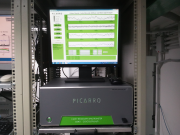
Monte Curcio (MCU) instruments: Picarro G2401 methane, carbon monoxide, carbon dioxide and water analyser. The Model G2401 is based on cavity ring-down spectroscopy (CRDS), capable of measuring the concentrations e compounds. This technique enables measurement of absolute optical extinction by samples that scatter and absorb light. A laser is used to illuminate a high-finesse optical cavity, which consists of two highly reflective mirrors. When the laser is in resonance with a cavity mode, intensity builds up in the cavity due to constructive interference. The laser is then turned off in order to allow the measurement of the exponentially decaying light intensity leaking from the cavity. During this decay, light is reflected back and forth thousands of times between the mirrors giving an effective path length for the extinction on the order of a few kilometres.
-
Monte Curcio (MCU) instruments: TSI CPC3775 - Condensation Particle Counter. The Model 3775 is a general purpose counter that can detect airborne particles down to 4 nanometres in diameter. It provides highly accurate measurements over a wide concentration range from 0 to 107 particles per cubic centimetre. In the Model 3775, an aerosol sample is drawn continuously through a heated saturator where butanol is vaporized and diffuses into the aerosol sample stream. Together, the aerosol sample and butanol vapor pass into a cooled condenser where the butanol vapor becomes supersaturated and ready to condense. Particles present in the sample stream serve as condensation nuclei. Once condensation begins, particles quickly grow into larger droplets and pass through an optical detector where they are counted easily. The instruments uses a laser-diode light source and diode photodetector to collect scattered light from particles.
-
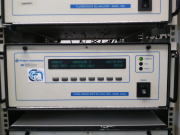
Monte Curcio (MCU) instruments: API Teledyne 200AU nitrogen oxide analyser. The Model 200AU uses chemiluminescence detection, coupled with microprocessor technology to provide ambient nitric oxide (NO), nitrogen dioxide (NO2) and the total nitrogen oxides (NOx). It calculates the amount of NO by measuring the amount of chemiluminescence given off when the sample gas is exposed to ozone (O3). A catalytic-reactive converter converts any NO2 in the sample gas to NO, which is then measured as above (including the original NO in the sample gas) and reported as NOx. NO2 is calculated as the difference between NOX and NO.
-
Monte Curcio (MCU) instruments: Fai Optical Particle Counter (OPC). The Hydra OPC is a multichannel optical particle counter for the real-time granulometric distribution characterization of the airborne particulate matter in the granulometric range involved in fine and coarse mass accumulation. Such a characterization gives both the particles number concentration of eight granulometric intervals ([µm]: 0.28, 0.4, 0.5, 0.7, 1.1, 2.0, 3.0, 5.0) of the measurement field and mass concentration data of the PM10, PM2,5 and PM1 fractions. The instrument holds a dryer cartridge suitable to keep the dilution air relative humidity under 60%. Measurement principle is based on laser scattering on elliptical mirror. The instrument gives counts per minute, with a dimensional sensitivity of 0.28 µm (50 ± 10% count efficiency).
-
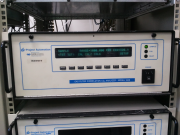
Monte Curcio (MCU) instruments: API Teledyne 360E carbon monoxide analyser. The Model 360E uses a method based on the Beer-Lambert law, an empirical relationship that relates the absorption of light to the properties of the material through which the light is travelling over a defined distance. In this case the light is infrared radiation (IR) travelling through a sample chamber filled with gas bearing a varying concentration of CO2.
-
Monte Curcio (MCU) instruments: Tekran 1130 Oxidized Mercury Speciation Module. The Model 1130 Oxidized Mercury Speciation Unit expands the Model 2537 Mercury Vapor Analyser capabilities to simultaneously monitor elemental and gaseous oxidized mercury (GOM and RGM) species in ambient air. It includes a Denuder module, a Pump module and the Zero Air Dryer Module. A specially coated annular denuder captures reactive mercury while allowing elemental mercury to pass through. During the sampling (adsorption) phase, the Model 2537 provides real time measurement of elemental mercury. During the analysis (desorption) phase, the denuder is flooded with Zero Air and heated. The captured reactive mercury is thermally desorbed and reduced to elemental form. The Model 2537 detects this eluted mercury, providing a measurement of total reactive mercury captured during the previous sampling period. The desorption process also regenerates the denuder coating. After cooling, the denuder is ready for another cycle. All timing parameters on the Model 1130 are programmable, allowing automatic RGM readings to be taken at user specified intervals.
-
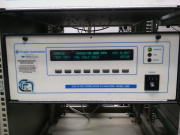
Monte Curcio (MCU) instruments: API Teledyne 400E ozone analyser. The Model 400E is an analyser that determines the concentration of ozone (O3) based on the Beer-Lambert law for measuring low ranges of ozone in ambient air. A 254 nm UV light signal is passed through the sample cell where it is absorbed in proportion to the amount of ozone present.
-
Monte Curcio (MCU) instruments: Tekran 2537 Total Gaseous Mercury (TGM) analyser. The Model 2537A Mercury Vapour Analyzer provides continuous analysis of total gaseous mercury (TGM) in air at sub-ng/m3 (parts per trillion (ppt) and parts per quadrillion (ppq)) levels. The instrument samples air and traps mercury vapour into a cartridge containing an ultra-pure gold adsorbent. The amalgamated mercury is thermally desorbed and detected using Cold Vapour Atomic Fluorescence Spectrometry (CVAFS). A dual cartridge design allows alternate sampling and desorption, resulting in continuous measurement of the air stream.
-
Monte Curcio (MCU) instruments: Tekran 1135 Particulate Mercury Analyser. The Model 1135 Particulate Mercury Module enables to continuously monitor ambient air particulate bound mercury (HgP). It is used with the Model 1130 Speciation Unit and the Model 2537 Mercury Analyser. During sampling, the coarse particle fraction (> 2.5 um) is captured in a heated impactor so that they do not enter the system. Reactive gaseous mercury species in the atmosphere are then captured in the Model 1130 Denuder Module. The fine fraction particulate bound mercury species are then trapped onto a unique quartz regenerable filter located within the Model 1135. Elemental mercury passes through both units and is continuously analyzed by the Model 2537. The sampling period and flow rate are programmable, and are usually set to be in the range 30 minutes to 3 hours at 10 L/m. These long sampling times and large flow rates are required to accumulate enough material for analysis.