
Contact for the resource
IBAF - CNR
11 record(s)
Type of resources
Available actions
Topics
Keywords
Contact for the resource
Provided by
Representation types
Update frequencies
Status
-

-

1 . Measurement platforms : • Building of measurement for monitoring outflows ( stilling of reinforced concrete and hydrological instrumentation to the closing section of the stream. • Within a fenced area , you have installed a metal tower 16 m high . At the top you have installed a telescopic pole steel to reach 9 m above the vegetation cover . The tower was installed most of the micrometeorological sensors , while on the pole additional sonic anemometer has been installed and the air sampling tube for the measurement of concentrations in the air of carbon dioxide and water vapor. In order to ensure the continuity of power to the energy measurements performed , were installed four solar panels ( 2 to 110 W and n . 2 70 W ) to 16 m in height , together with 8 batteries 6 V x 240 Ah . 2 . Instrumentation in-situ : • Hydrological Instrumentation basic ( idrometrografo ) , to be strengthened • Instrumentation to measure the exchange of CO2 and water vapor follows: gas analyzer ' closed path' fast-response LiCor 7000 ( LiCor , Lincoln , Nebraska - USA) ; CSAT -3 sonic anemometer ( Campbell Scientific , Logan, Utah - USA ) ; pump " brushless " by 11 l min- l ( KNF Neuberger GmbH , Germany) • micrometeorological sensors for the measurement of: a. Net radiation sensor ( Middleton , Brunswick, Victoria, Australia) ; b . Components of long-wave (infrared) and shortwave ( global radiation ) ( radiometer CNR1 , Kipp & Zonen ) ; c . Photosynthetically active radiation ( PAR sensor , LiCor , Lincoln , Nebraska - USA) ; d. Temperature and humidity of the air above the canopy , to 2 m in height and soil temperature at 5 and 20 cm depth ( PT100 sensors , MICROS Srl , Treviso , Italy) ; and . Soil heat flux ( REBS sensor , Campbell) ; f . 0-30 cm soil water content ( CS615 , Seattle, Washington, USA) ; g . Rain gauge Voices ( sensor MICROS , Italy). • Data- logger CR 5000 ( Campbell Scientific) is used for the collection of data at high frequency (20 Hz) for the measurement of turbulence and flows, both for the collection of micrometeorological data.
-

-
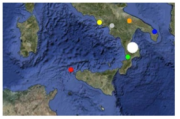
Geographical Coordinates: - Latitude: 39° 25' N - Longitude: 16° 12' E The basin Bonis (39 ° 25'15 '' N and 16 ° 12'38 '') is located in the Sila Cosenza and is a sub-basin of the river Cino. It has an area of 139 hectares. The basin , public property , was identified and designed from 1984 and equipped in 1986 with the aim of establishing a permanent laboratory for the study of the water balance at the basin level and water processes at the scale of slopes ( sub-basins ) , in forest stands ( Corsican pine ) , also in relation to the evolutionary dynamics leading to thinning operations . The monitoring of the outflows was carried out with the realization, in the closing section , of a building of measurement consists of a stilling reinforced concrete . The stretch of river bed upstream of the tank is channeled to a length of 32 meters and in the end parts extends in the shape of a funnel to link up with a bridle in cement concrete on the one hand and with the tank on the other side . From the point of view of forest cover the surface is affected by the 80% of populations of Corsican pine (Pinus laricio Poiret ) , largely man-made , made in the period between 1955 and 1970. The nuclei of natural origin , age next to that of reforestation , occupy the highest part of the pelvis in the left and right bank . Within the basin , in May 2003 , in the village Cozzarella - Don Bruno , a tower was installed to measure the mass exchange (CO2 , H2O) and energy (sensible heat , H) between forest and atmosphere that makes use the eddy covariance technique . The tower is the site of forest further south in Italy and has the objective to study the dynamics of carbon exchange and evapotranspiration of a reforestation of Corsican pine . The decision to install the measuring station for the exchange of CO2 and water vapor in this basin was made to adopt an integrated measure of the hydrosphere - biosphere - atmosphere interactions . The station was installed in an artificial pine forest about 35 years old, planted on former pasture and sparse in 1986 , which represents the main ecosystem of the basin , and a principal of the Calabria region .. The morphology is slightly wavy . The geological substrate is composed of granitic rocks , the soils belong to the association Ultic Haploxeralfs , characterized by a clayey horizon with illuvial clay focused, often , even in the strip ( Dimase & Iovino 1996 Castrignanò & Buttafuoco 2004). From the point of view phytoclimatic the area is due to the hot sub Fagetum ( Pavari 1916) On the phytosociological , the pine forest is attributable to the association Hypochoerido - Pinetum laricionis , which can implant in areas uncovered by forming consortia which is generally quite sparse . The pine forest has 637 trees per hectare, basal area of 45.4 m2 ha-1 , mean diameter of 29 cm and average height of 21.5 m , the leaf area index , measured with the LAI -2000 ( LiCor , Lincoln , Nebraska - USA ) was of 6.6 ± 0:18 m2 m -2. At this site are active , since June 2003, micrometeorological measurements and instrumentation to measure the exchange of carbon and water vapor.
-

-

-

-

-

-
