
Keyword
Kala Patthar
16 record(s)
Type of resources
Available actions
Topics
Keywords
Contact for the resource
Provided by
Representation types
Update frequencies
Status
-
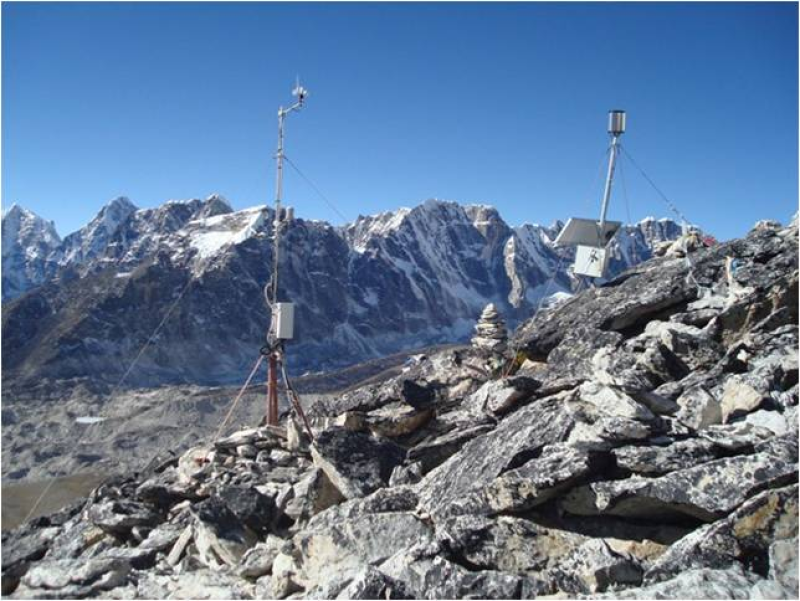
In the Khumbu Valley, located in the central part of the Himalayan range and including the area of Sagarmatha National Park, a network of 7 Automatic Weather Stations (AWSs) has been installed since 1994. These weather stations are located at different altitudes: Lukla (2,660 m a.s.l), Namche (3,570 m a.s.l), Periche (4,260 m a.s.l), Lobuche (5,050 m a.s.l) near the Pyramid - Laboratory Observatory, Kala Patthar (5,600 m a.s.l), Changri Nup Glacier (5,700 m a.s.l) and Mt. Everest - South Col (8.000 m a.s.l). The network mainly takes measurements of 7 standards parameters: air temperature, relative humidity, atmospheric pressure, wind speed and direction, global radiation and total precipitation. Meteo-climatic observations in this area are very important to better understand the environmental changes that are affecting the ecosystem, helping the scientific community to improve the prediction of this environmental phenomena’s evolution and modification. The Kala Patthar AWS was installed on May 2008, at 5600 m asl. Geographical coordinated: - Latitude: 27° 59' 24" N - Longitude: 86° 49' 48" E
-

At the Kala Patthar station the the CM6B pyranometer, manufactured by Kipp & Zonen is installed. This sensor is a first class pyranometer as defined by the World Meteorological Organization. It is suitable for the measurement of solar irradiance on a plane surface (W/m2). It incorporates a 64-thermocouple sensor, which is rotationally symmetrical, housed under K5 domes. A white screen prevents the body of the pyranometer from heating up. The pyranometer is supplied with a spirit level and screws for accurate levelling. CM6B technical characteristics: - Spectral range 305 to 2800 nm (50%points) - Sensitivity 9 to 15 ?V/Wm-2 - Impedance 70 to 100 Ohm - Response time 1/e 5 s, 99 % 55 s - Non-linearity <1.5 % (<1000 W/m 2 ) - Tilt error <1.5 % at 1000 W/m 2 - Operating temperature -40 to +90 °C - Temperature dependence of sensitivity _2 % (-10 to +40 °C) - Maximum irradiance 2000 W/m2 - Directional error < _20 W/m2 at 1000 W/m2 - Weight 0.85 kg - Cable length 10 m
-

At the AWS Kala Patthar station the DQA030 rain gauge is manufactured by LSI-Lastem equipped with a siphon placed on the cone's nozzle; it has two functions: during light rain the drizzle falls on the bascule without moving it and therefore evaporates without being measured; during heavy rain, it regulates the flow into the bascule permitting all the water to fall inside. LSI-LASTEM rain gauges have stainless steel housing whereas the cone has been designed to avoid the drops splash phenomena and to allow water droplets to dribble down inside even in case of very light rain. The rain gauge can be placed either directly on the ground by means of the DYA042 base plate or mounted on the top or the side of 50 mm diameter. For sites with sub-zero temperatures, the thermostatic heated models ensure the complete melting of snow, even at extreme temperature, whereas minimizing losse of evaporation; these models are insulated to reduce heat dispersion. Technical characteristic: Collettor surface area: 324 cmq Collector area diameter: 203 mm Measurement range: Max 10 mm/min Resolution: 0.2 mm/imp. (opt. 0.1, 0.5 mm/imp) Accuracy: 0-1 mm/min: +- 1 basculata/tip 1-10 mm/min:1% Contact: 1 reed (opt. N.2 REED) 0.5 a/24v non inductive Pulse duration: 100 msec+-50 Collector cone material: Aluminium External housing material: Aluminium Tipping bucket material: Aluminium
-

The CX115P Lsi-Lastem barometer is connected with a measurement system (recorder, data logger) that accepts analog signals. The barometer works according to the piezometric principle: a resistive film is deposited on a slice of silica with a bridge form; as the pressure changes, the slice will deform and consequently changes the system's resistance. The CX115P model mounts a special thermal compensation system that significantly reduces drift. General characteristics: Range: 800 ž 1100 hPa (1 hPa=1 mBar) Sea level correction range: -300...+2000 mt. Thermal drift: 0,01 hPa/°C (-10..+60°C) Linearity&Hysteresis: < 0,3% of the range Overload: max. 2 Pa Load resi stance: Current output types: <500W. Power consumption: 3 W Response time (T90): 1 ms Environmental limits: -25 .. +60°C Output connections: terminals Weight: 650 gr. Housing case material: Plastic Protection: IP40 Downward cable outlet
-

At the Kala Patthar station the the CM6B pyranometer, manufactured by Kipp & Zonen is installed. This sensor is a first class pyranometer as defined by the World Meteorological Organization. It is suitable for the measurement of solar irradiance on a plane surface (W/m2). It incorporates a 64-thermocouple sensor, which is rotationally symmetrical, housed under K5 domes. A white screen prevents the body of the pyranometer from heating up. The pyranometer is supplied with a spirit level and screws for accurate levelling.
-

The CX115P Lsi-Lastem barometer is connected with a measurement system (recorder, data logger) that accepts analog signals. The barometer works according to the piezometric principle: a resistive film is deposited on a slice of silica with a bridge form; as the pressure changes, the slice will deform and consequently changes the system's resistance. The CX115P model mounts a special thermal compensation system that significantly reduces drift.
-

The DNA022 Lsi-Lastem combined wind speed-direction sensor is mounted on a 5m pole on Kala Patthar station in 2008. The CombiSD sensor includes, in a single apparatus, the both transducers for measuring wind speed and wind direction. Its use simplifies the installation and the plant design in respect of the sensors with separate measurements plus giving some other advantages being smaller, lighter and cheaper. The CombiSD DNA022: sensor has a direct signal output. Frequency (Hz) for wind speed and resistance (Ohm) for wind direction. The CombiSD has low power consumption, it can be used in systems with small energy availability.
-

The DMA572 Thermohygrometer by Lsi-Lastem was installed on 2008 at Kala Patthar. It is a probe for measuring air temperature and relative humidity with replaceable sensitive element for simplify calibration and maintenance. LSI-Lastem supplies a precise and reliable set of probes, suitable for a continuous measurement in severe environments, in presence of deep thermal and hygrometric ranges with high sun radiant heat. An important feature of this set of sensor is that the thermohygrometric sensitive element is easily replaceable, in order to have a simple and rapid ordinary maintenance and avoiding calibration. The Thermohygrometer has supported a considerable improvement, owing to a deep technical and styling development process: a fan ensures a continuous air change around the sensor in order to eliminate temperature fault caused by radiant heat.
-

The DMA572 Thermohygrometer by Lsi-Lastem was installed on 2008 at Kala Patthar. It is a probe for measuring air temperature and relative humidity with replaceable sensitive element for simplify calibration and maintenance. LSI-Lastem supplies a precise and reliable set of probes, suitable for a continuous measurement in severe environments, in presence of deep thermal and hygrometric ranges with high sun radiant heat. An important feature of this set of sensor is that the thermohygrometric sensitive element is easily replaceable, in order to have a simple and rapid ordinary maintenance and avoiding calibration. The Thermohygrometer has supported a considerable improvement, owing to a deep technical and styling development process: a fan ensures a continuous air change around the sensor in order to eliminate temperature fault caused by radiant heat.
-

The DMA572 Thermohygrometer by Lsi-Lastem was installed on 2008 at Kala Patthar. It is a probe for measuring air temperature and relative humidity with replaceable sensitive element for simplify calibration and maintenance. LSI-Lastem supplies a precise and reliable set of probes, suitable for a continuous measurement in severe environments, in presence of deep thermal and hygrometric ranges with high sun radiant heat. An important feature of this set of sensor is that the thermohygrometric sensitive element is easily replaceable, in order to have a simple and rapid ordinary maintenance and avoiding calibration. The Thermohygrometer has supported a considerable improvement, owing to a deep technical and styling development process: a fan ensures a continuous air change around the sensor in order to eliminate temperature fault caused by radiant heat.