
Keyword
Elena Glacier
19 record(s)
Type of resources
Available actions
Topics
Keywords
Contact for the resource
Provided by
Representation types
Update frequencies
Status
-

In the framework of Ev-K2-CNR / SHARE (Stations at High Altitude for Research on the Environment) project the first permanent Automatic Weather Station (AWS) has been installed in Uganda, on July 18, 2006 in the western part of the Stanley Plateau, the biggest Rwenzori glacial mass. The Project was carried out during the celebration of Mt. Ruwenzori first ascent by Duke of Abruzzi in 1906 . This station has the same technical characteristics of the Ev-K2- CNR networks located in the high altitude regions of Himalaya and Karakorum. The station records continuously measurements of the seven meteorological standard parameters: air temperature, relative humidity, wind speed and direction, atmospheric pressure, global solar radiation and total precipitation. The Rwenzori observations will permit to study physical and dynamical processes at Africa high elevations in the framework of SHARE and GEWEX-CEOP HE programs to improve our understanding of variability and change in hydrological and energy cycles and their role in the climate system.
-

The station records continuously measurements of the seven meteorological standard parameters: air temperature, relative humidity, wind speed and direction, atmospheric pressure, global solar radiation and total precipitation. A barometer CX115P LSI-Lastem (Italy), measures atmospheric pressure (hPa).
-

The CNR 4 net radiometer consists of a pyranometer pair, one facing upward, the other facing downward, and a pyrgeometer pair in a similar configuration. The pyranometer pair measures the short-wave radiation. And the pyrgeometer pair measures long-wave radiation. The upper long-wave detector of CNR 4 has a meniscus dome. This ensures that water droplets role off easily and improves the field of view to nearly 180°, compared with a 150° for a flat window. All 4 sensors are integrated directly into the instrument body, instead of separate modules mounted onto the housing. But are each calibrated individually for optimal accuracy. Two temperature sensors, a Pt-100 and Thermistor, are integrated for compatibility with every data logger. The temperature sensor is used to provide information to correct the infrared readings for the temperature of the instrument housing. Care has been taken to place the long-wave sensors close to each other and close to the temperature sensors. This assures that the temperatures of the measurement surfaces are the same and accurately known. Which improves the quality of the long-wave measurements. Technical Characteristics: Spectral range: 300 to 2800 (short wave) nm Spectral range: 4500 to 42000 (long wave) nm Sensitivity: 5 to 20 µV/W/m² Temperature dependence of sensitivity (-10 ºC to +40 ºC) : < 4 % Response time: < 18 s Non-linearity: < 1 % Operating temperature: -40 to 80 °C Ventilation power (of the optional CNF 4 ventilation unit): 10 W
-

The station records continuously measurements of the seven meteorological standard parameters: air temperature, relative humidity, wind speed and direction, atmospheric pressure, global solar radiation and total precipitation. A thermohygrometer DMA572 LSi-Lastem(Italy) measures : -air temperature (°C); - relative humidity(%).
-

The station records continuously measurements of the seven meteorological standard parameters: air temperature, relative humidity, wind speed and direction, atmospheric pressure, global solar radiation and total precipitation. A barometer CX115P LSI-Lastem (Italy), measures atmospheric pressure (hPa).
-

In the framework of Ev-K2-CNR / SHARE (Stations at High Altitude for Research on the Environment) project the first permanent Automatic Weather Station (AWS) has been installed in Uganda, on July 18, 2006 in the western part of the Stanley Plateau, the biggest Rwenzori glacial mass. The Project was carried out during the celebration of Mt. Ruwenzori first ascent by Duke of Abruzzi in 1906 . This station has the same technical characteristics of the Ev-K2- CNR networks located in the high altitude regions of Himalaya and Karakorum. The station records continuously measurements of the seven meteorological standard parameters: air temperature, relative humidity, wind speed and direction, atmospheric pressure, global solar radiation and total precipitation. The Rwenzori observations will permit to study physical and dynamical processes at Africa high elevations in the framework of SHARE and GEWEX-CEOP HE programs to improve our understanding of variability and change in hydrological and energy cycles and their role in the climate system.
-
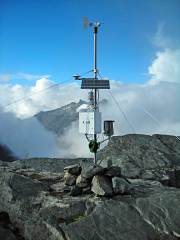
The Rwenzori Mountains (called also “Mountains of the Moon”), with heights of up to 5,109 m asl., are located in the central Africa, on the border between Uganda and the Democratic Republic of Congo, in the Ugandan National Park an UNESCO World Heritage Site. In the Rwenzori Range some of the main peaks are covered with permanent snow and glacier, while the lower slopes are covered with dense forest. Besides there are several massifs such as Point Margherita, the third highest African summit after, Mt. Kilimanjaro and Mt. Kenya. The first AWS (Automatic Weather Station) RW was installed, in Uganda, in the western part of the Stanley Plateau, on July 18, 2006. This station worked in continuous from 2006 to 2009. In 2009 the station interruppted its work due to difficult environmental conditions, and in 2013 this station was replaced with a new one. Geographical coordinates: - Latitude: 0° 22' 34.55" N - Longitude: 29° 52' 43.24" E - Elevation: 4.750 m a.s.l.
-

The station records continuously measurements of the seven meteorological standard parameters: air temperature, relative humidity, wind speed and direction, atmospheric pressure, global solar radiation and total precipitation. A thermohygrometer DMA572 LSi-Lastem(Italy) measures : -air temperature (°C); - relative humidity(%).
-

The station records continuously measurements of the seven meteorological standard parameters: air temperature, relative humidity, wind speed and direction, atmospheric pressure, global solar radiation and total precipitation. A thermohygrometer DMA572 LSi-Lastem(Italy) measures : -air temperature (°C); - relative humidity(%).
-

The Vaisala HUMICAP® Humidity and Temperature Probe HMP155 provides reliable humidity and temperature measurement. It is designed especially for demanding outdoor applications. Features/Benefits ▪ Vaisala HUMICAP®180R sensor - superior long-term stability ▪ Optional warmed humidity probe and chemical purge ▪ Plug-and-play ▪ USB connection for service use ▪ Fits with DTR13 and DTR503 radiation shields and also for a Stevenson screen ▪ Weather-proof housing IP66 ▪ Optional, fast temperature probe ▪ Different output possibilities: voltage, RS-485, resistive Pt100 ▪ Applications: meteorology, aviation and road weather, instrumentation