
Keyword
DInSAR analysis
20 record(s)
Type of resources
Available actions
Topics
Keywords
Contact for the resource
Provided by
Representation types
Update frequencies
Status
Scale
-
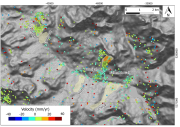
Relatively to the Upper Tena Valley test site, a space-born analysis using the PSInSAR technique, was processed by Altamira information (http://www.altamira-information.com/), available by the Framework Agreement between NextData Project and Terrafirma (the agreement was signed in July 2014. The SAR images were selected in an ERS-1/2 descending dataset that includes images spanning the April 1995 and the December 2000 time period. The ERS-1/2 satellite acquires images characterized by: - Band acquisition: C Band - Wavelength (cm): 5.6 - Incident angle (°): 23° - Resolution azimuth/range (m): ≈ 6/24 - Revisit time (days): 35 - Life status: 1992 - 2001 - Space agency: ESA The archived PS measurements are provided in geocoded coordinates (UTM WGS84), and are reported in an ASCII format.
-
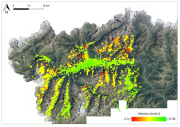
Relatively to the Valle d’Aosta region test site, a space-borne analysis, using the DInSAR technique, was done using the ESA’s Grid Processing On-Demand (G-POD) service. The ASAR-Envisat dataset, available through the Virtual Archive 4 of ESA (by the Category-1A project, part of the ESA Geohazard Supersites initiative), was processed by using the G-POD service. The SAR dataset, made of 38 images acquired from ascending orbit (track 301) between June 2004 and November 2010, has been analyzed with the SBAS-DInSAR technique. The ASAR-Envisat satellite acquires images characterized by: - Band acquisition: C Band - Wavelength (cm): 5.6 - Incident angle (°): 23° - Azimuth/ground range resolution (m): ≈ 4/20 - Revisit time (days): 35 - Life status: 2002 – 2010 - Space agency: ESA Regarding the G-POD threshold setting of the SBAS processing, the following parameters were used: - Max Perpendicular Baseline (m): 400 - Max Temporal Baseline (days): 1500 - Ground Pixel Dimension (m): 40 - Coherence Threshold: 0.8 - Area of Interest (AOI): entire frame - REF point: Lat. 45.737049 – Lon. 7.31899 The achieved SBAS measurements are provided in geocoded coordinates (Lat./Lon. and UTM WGS84), and are reported in an ASCII file. The SBAS results, relevant to the entire frame (normally around 100x100 km), have an accuracy of 1 mm/yr concerning the mean velocity measurements, and 5 mm for the deformation measurements [Casu et al., 2006]
-
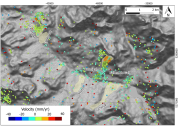
The SAR ground deformation time series relevant to Upper Tena Valley include deformation data obtained from the ERS-1/2 satellite acquisition (produced by Altamira and available by the Framework Agreement between NextData Project and Terrafirma, signed in July 2014), and elaborated by PSInSAR technique. In particular, the analysis provided 2742 measure points, for the observed period from April 1995 to December 2000. The analysis provided for each PS: - CODE - East and North UTM WGS84 coordinates (m); - Azimuth and Range coordinates [Azimuth/Range.]; - Height (m); - Deformation Velocity (cm/yr.) [VEL]; - Temporal interferometric coherence [COHERENCE]; - Standard deviation [STDDEV]; - Unwrapping group; - Deformation Data (mm), related to the date of the exploited SAR images. The deformation time series present a monthly temporal sampling, and provide long time series of deformation, allowing to follow the evolution of surface displacements over time.
-
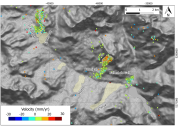
Relatively to the Upper Tena Valley test site, a space-born analysis using the PSInSAR technique, was processed by Altamira information (http://www.altamira-information.com/), available by the Framework Agreement between NextData Project and Terrafirma (the agreement was signed in July 2014). The ASAR-Envisat images were selected in an Envisat ASAR descending dataset that includes images spanning the July 2001 and the September 2007 time period. The ASAR-Envisat satellite acquires images characterized by: - Band acquisition: C Band - Wavelength (cm): 5.6 - Incident angle (°): 23° - Resolution azimuth/range (m): ≈ 4/20 - Revisit time (days): 35 - Life status: 2002 - 2010 - Space agency: ESA The achieved PS measurements are provided in geocoded coordinates (UTM WGS84), and are reported as ASCII format.
-
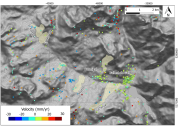
Relatively to the Upper Tena Valley test site, a space-born analysis using the PSInSAR technique, was processed by Altamira information (http://www.altamira-information.com/), available by the Framework Agreement between NextData Project and Terrafirma (the agreement was signed in July 2014). The SAR images were selected in an ASAR-Envisat ascending dataset that includes images spanning the October 2002 and the July 2007 time period. The ASAR-Envisat satellite acquires images characterized by: - Band acquisition: C Band - Wavelength (cm): 5.6 - Incident angle (°): 23° - Resolution azimuth/range (m): ≈ 4/20 - Revisit time (days): 35 - Life status: 2002 - 2010 - Space agency: ESA The achieved PS measurements are provided in geocoded coordinates (UTM WGS84), and are reported as ASCII format.
-
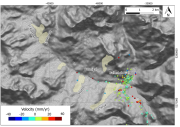
Relatively to the Upper Tena Valley test site, a space-born analysis using the PSInSAR technique, was done by Altamira information (http://www.altamira-information.com/), available by the Framework Agreement between NextData Project and Terrafirma (the agreement was signed in July 2014). The SAR images were selected in an ERS-1/2 ascending dataset that includes images spanning the June 1995 and the July 1998 time period. The ERS-1/2 satellite acquires images characterized by: - Band acquisition: C Band - Wavelength (cm): 5.6 - Incident angle (°): 23° - Resolution azimuth/range (m): ≈ 6/24 - Revisit time (days): 35 - Life status: 1992 - 2001 - Space agency: ESA The archived PS measurements are provided in geocoded coordinates (UTM WGS84), and are reported in an ASCII format.
-
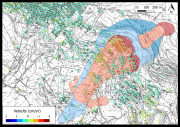
The Ivancich SAR ground deformation time series include deformation data obtained from Cosmo SkyMED satellite acquisition, and published in: Calò et al. (2014) Enhanced landslide investigations through advanced DInSAR techniques: The Ivancich case study, Assisi, Italy. Remote Sensing of Environment, 142: 69-82. This dataset is a courtesy of Ing. Maceo Giovanni Angeli (IRPI-CNR) and Dr. Geol. Fabrizio Pontoni (private consultant). In particular provide 118147 SBAS targets displacement (relative to the Assisi municipality, Monte Subasio and Valle Umbra territory), in descending orbit and in low-resolution scale (100mx100m), for the observed period from December 2009 to February 2012. The archive provide for each SBAS targets: - X (East) and Y (North) UTM WGS84 coordinates (m); - Temporal interferometric coherence [coer.]; - Deformation velocity (cm/year) [vel.]; - Azimuth and Range coordinates [azimuth/range]; - Latitude and Longitude coordinates (deg.) [Lat./Lon]; - Topography (m) [topo]; - Deformation Data (cm), related to the date of the exploited SAR images. The date of the exploited images are expressed as: day/month/year. The time series present a weekly temporal sampling, and provide long-time series of deformation, allowing to following the evolution of surface displacement over time.
-
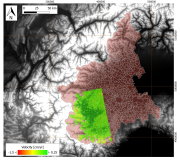
The SAR ground deformation time series relevant to Sampeyre frame include deformation data obtained from ASAR-Envisat satellite acquisitions (images available in the framework of Category-1A project, part of the ESA Geohazard Supersites initiative), and elaborated by the ESA’s G-POD service with the SBAS technique. In particular, the analysis provided 65535 measure points, for the observed period from April 2005 to October 2010, relative to the entire frame. The archive provide for each SBAS targets: - ID: Gr1; Gr2; Gr n - East and North UTM WGS84 coordinates (m); - Temporal interferometric coherence [CohT]; - Deformation velocity (cm/year) [Vel]; - Azimuth and Range coordinates [Az/Rg]; - Latitude and Longitude coordinates (deg) [Lat/Lon]; - Topography (m) [RT]; - Deformation Data (cm), related to the date of the exploited SAR images. The date of the exploited images are expressed as: [year+((month-1)*30+day)/365]. The SBAS results, relevant to the entire frame (normally around 100x100 km), have an accuracy of 1 mm/yr for mean velocity measurements, and 5 mm for the deformation measurements [Casu et al., 2006]. The deformation time series present a monthly temporal sampling, and provide long time series of deformation, allowing to follow the evolution of surface displacement over time.
-
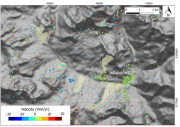
The SAR ground deformation time series relevant to Upper Tena Valley include deformation data obtained from the ERS-1/2 satellite acquisition (produced by Altamira and available by the Framework Agreement between NextData Project and Terrafirma, signed in July 2014), and elaborated by PSInSAR technique. In particular, the analysis provided 926 measure points, for an observed period from October 2002 to July 2007. The analysis provided for each PS: - CODE - East and North UTM WGS84 coordinates (m); - Azimuth and Range coordinates [Azimuth/Range.]; - Height (m); - Deformation Velocity (cm/yr.) [VEL]; - Temporal interferometric coherence [COHERENCE]; - Standard deviation [STDDEV]; - Unwrapping group; - Deformation Data (mm), related to the date of the exploited SAR images. The deformation time series present a monthly temporal sampling, and provide long time series of deformation, allowing to follow the evolution of surface displacements over time.
-
Relatively to the Grange Orgiera test site, a space-born analysis, using the DInSAR technique, was done using the ESA’s Grid Processing On-Demand (G-POD) service, for the entire frame considered. The ASAR-Envisat dataset, available through the Virtual Archive 4 of ESA (by the Category-1A project, part of the ESA Geohazard Supersites initiative), was processed by using the G-POD service. The SAR dataset, made of 21 images acquired in ascending orbit (track 301) between April 2005 and October 2010, has been analyzed with the SBAS-DInSAR technique. The ASAR-Envisat satellite acquires images characterized by: - Band acquisition: C Band - Wavelength (cm): 5.6 - Incident angle (°): 23° - Azimuth/ground range resolution (m): ≈ 4/20 - Revisit time (days): 35 - Life status: 2002 – 2010 - Space agency: ESA Regarding the G-POD threshold setting of the SBAS processing, the following parameters were used: - Max Perpendicular Baseline (m): 400 - Max Temporal Baseline (days): 1500 - Ground Pixel Dimension (m): 80 - Coherence Threshold: 0.7 - Area of Interest (AOI): entire frame - REF point: Lat. 44.5838 – Lon. 7.1434 The achieved SBAS measurements provided in geocoded coordinates (Lat/Lon and UTM WGS84), and are reported in an ASCII file. The SBAS results, relevant to the entire frame (normally around 100x100 km), have an accuracy of 1 mm/yr concerning the mean velocity measurements, and 5 mm for the deformation measurements [Casu et al., 2006].