
Keyword
CNR IRPI
35 record(s)
Type of resources
Available actions
Topics
Keywords
Contact for the resource
Provided by
Representation types
Update frequencies
Status
Scale
-
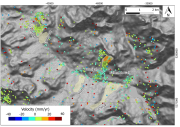
Relatively to the Upper Tena Valley test site, a space-born analysis using the PSInSAR technique, was processed by Altamira information (http://www.altamira-information.com/), available by the Framework Agreement between NextData Project and Terrafirma (the agreement was signed in July 2014. The SAR images were selected in an ERS-1/2 descending dataset that includes images spanning the April 1995 and the December 2000 time period. The ERS-1/2 satellite acquires images characterized by: - Band acquisition: C Band - Wavelength (cm): 5.6 - Incident angle (°): 23° - Resolution azimuth/range (m): ≈ 6/24 - Revisit time (days): 35 - Life status: 1992 - 2001 - Space agency: ESA The archived PS measurements are provided in geocoded coordinates (UTM WGS84), and are reported in an ASCII format.
-
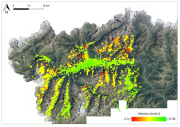
Relatively to the Valle d’Aosta region test site, a space-borne analysis, using the DInSAR technique, was done using the ESA’s Grid Processing On-Demand (G-POD) service. The ASAR-Envisat dataset, available through the Virtual Archive 4 of ESA (by the Category-1A project, part of the ESA Geohazard Supersites initiative), was processed by using the G-POD service. The SAR dataset, made of 38 images acquired from ascending orbit (track 301) between June 2004 and November 2010, has been analyzed with the SBAS-DInSAR technique. The ASAR-Envisat satellite acquires images characterized by: - Band acquisition: C Band - Wavelength (cm): 5.6 - Incident angle (°): 23° - Azimuth/ground range resolution (m): ≈ 4/20 - Revisit time (days): 35 - Life status: 2002 – 2010 - Space agency: ESA Regarding the G-POD threshold setting of the SBAS processing, the following parameters were used: - Max Perpendicular Baseline (m): 400 - Max Temporal Baseline (days): 1500 - Ground Pixel Dimension (m): 40 - Coherence Threshold: 0.8 - Area of Interest (AOI): entire frame - REF point: Lat. 45.737049 – Lon. 7.31899 The achieved SBAS measurements are provided in geocoded coordinates (Lat./Lon. and UTM WGS84), and are reported in an ASCII file. The SBAS results, relevant to the entire frame (normally around 100x100 km), have an accuracy of 1 mm/yr concerning the mean velocity measurements, and 5 mm for the deformation measurements [Casu et al., 2006]
-
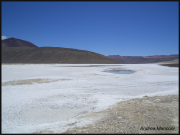
The Atacama Desert is a plateau located in South America, where ground surface deformation (uplift) was revealed by space-borne InSAR analysis on salt lakes, named Salars. These salars are located at about 4000-5000 m asl, in the Atofagasta region, in a hyperarid desert, one of the driest place on the Earth, and are characterized by saline detritic crust and efflorescences caused by water movement. The uplift revealed is probably related to the regional decrease of the permafrost elevation, which may contribute to an increase in the annual volume of incoming groundwater. In that area several flanks of inactive volcanoes show gravitational processes, which might also be related to the decadal diminution of the permafrost elevation.
-
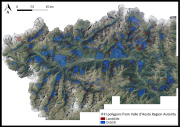
The Valle d’Aosta is the region in the northwest Italy, with an extension of about 3262 km2, sets mainly in the Pennine and Graie Alps. In this context, landslides play an important role in the evolution of the mainly regional territory. In particular, the Valle d’Aosta region is one of the Italian region characterized by higher number of landslides, where landslide affecting an area of 520,35 km2 of the regional territory [Giardino & Ratto, 2007]. The entire territory has been investigated by space-borne technique, using the DInSAR technique by the ESA’s Grid Processing On-Demand (G-POD) service.
-
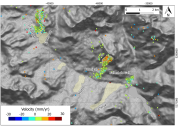
Relatively to the Upper Tena Valley test site, a space-born analysis using the PSInSAR technique, was processed by Altamira information (http://www.altamira-information.com/), available by the Framework Agreement between NextData Project and Terrafirma (the agreement was signed in July 2014). The ASAR-Envisat images were selected in an Envisat ASAR descending dataset that includes images spanning the July 2001 and the September 2007 time period. The ASAR-Envisat satellite acquires images characterized by: - Band acquisition: C Band - Wavelength (cm): 5.6 - Incident angle (°): 23° - Resolution azimuth/range (m): ≈ 4/20 - Revisit time (days): 35 - Life status: 2002 - 2010 - Space agency: ESA The achieved PS measurements are provided in geocoded coordinates (UTM WGS84), and are reported as ASCII format.
-
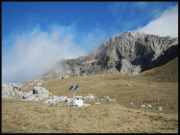
The Upper Tena Valley is located in the Central Spanish Pyrenees, between Sallent de Gallego and El Portalet municipality. This area is characterized by hundreds landslides different in type and in particular by two deep-seated slides whose development is due to the destabilization of the over steepened valley walls after the retreat of the glaciers (Herrera et al., 2013). This territory has been investigated by geomorphological investigation, in situ geotechnical investigation of the portion of the area that is involved in the two deep-seated slides, to exploit the possibility to detect a relationship between change of the rate of the landslides displacement and climatic parameters. Furthermore this territory has been investigated by space-borne technique. In particular, the SAR images were processed by PSInSAR technique by Altamira information (http://www.altamira-information.com/), available by the Framework Agreement between NextData Project and Terrafirma (the agreement was signed in July 2014).
-
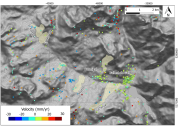
Relatively to the Upper Tena Valley test site, a space-born analysis using the PSInSAR technique, was processed by Altamira information (http://www.altamira-information.com/), available by the Framework Agreement between NextData Project and Terrafirma (the agreement was signed in July 2014). The SAR images were selected in an ASAR-Envisat ascending dataset that includes images spanning the October 2002 and the July 2007 time period. The ASAR-Envisat satellite acquires images characterized by: - Band acquisition: C Band - Wavelength (cm): 5.6 - Incident angle (°): 23° - Resolution azimuth/range (m): ≈ 4/20 - Revisit time (days): 35 - Life status: 2002 - 2010 - Space agency: ESA The achieved PS measurements are provided in geocoded coordinates (UTM WGS84), and are reported as ASCII format.
-
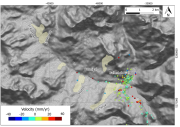
Relatively to the Upper Tena Valley test site, a space-born analysis using the PSInSAR technique, was done by Altamira information (http://www.altamira-information.com/), available by the Framework Agreement between NextData Project and Terrafirma (the agreement was signed in July 2014). The SAR images were selected in an ERS-1/2 ascending dataset that includes images spanning the June 1995 and the July 1998 time period. The ERS-1/2 satellite acquires images characterized by: - Band acquisition: C Band - Wavelength (cm): 5.6 - Incident angle (°): 23° - Resolution azimuth/range (m): ≈ 6/24 - Revisit time (days): 35 - Life status: 1992 - 2001 - Space agency: ESA The archived PS measurements are provided in geocoded coordinates (UTM WGS84), and are reported in an ASCII format.
-
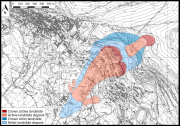
The Ivancich landslide is a phenomenon located in Assisi municipality (PG), in Umbria region, which affects the northern sector of the city. From a geomorphological point of view, this event is an old translational slide with a rotational component in the source area. The landslide has been divide in an active sector, distinguishing in the crow area (dark red in the picture) and the landslide deposits (light red in the picture), and an ancient relict sector, distinguishing in the crown area (dark blue in the picture) and the landslide deposits (light blue in the picture) [From: Antonini, G., Ardizzone, F., Cacciano, M., Cardinali, M., Castellani, M., Galli, M., Guzzetti, F., Reichenbach, P., Salvati, P., 2002a. Rapporto Conclusivo Protocollo d'Intesa fra la Regione dell'Umbria, Direzione Politiche Territoriali Ambiente e Infrastrutture, ed il CNR–IRPI di Perugia per l'acquisizione di nuove informazioni sui fenomeni franosi nella regione dell'Umbria, la realizzazione di una nuova carta inventario dei movimenti franosi e dei siti colpiti da dissesto, l'individuazione e la perimetrazione delle aree a rischio da frana di particolare rilevanza, e l'aggiornamento delle stime sull'incidenza dei fenomeni di dissesto sul tessuto insediativo, infrastrutturale e produttivo regionale. Unpublished report, May 2002, 140 pp., (in Italian)]. The landslide is extended from an elevation of 660 m asl to 350 m asl, and involves in a debris deposits. This landslide was monitored with geological and engineering investigations since the 1970’s, consequently roads and buildings damages registered. In particular the Ivancich landslide was monitored from 1982 to 2008 with topographic and inclinometer measurements. The data refer to an extended monitoring network of the landslide and in particular the data of the inclinometer number 103, 113B, 117, and 202 were published in Calò et al. (2014) "Enhanced landslide investigations through advanced DInSAR techniques: The Ivancich case study, Assisi, Italy" Remote Sensing of Environment, 142: 69-82. This dataset is a courtesy of Ing. Maceo Giovanni Angeli (IRPI-CNR) and Dr. Geol. Fabrizio Pontoni (private consultant).
-
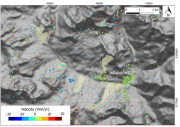
The SAR ground deformation time series relevant to Upper Tena Valley include deformation data obtained from the ERS-1/2 satellite acquisition (produced by Altamira and available by the Framework Agreement between NextData Project and Terrafirma, signed in July 2014), and elaborated by PSInSAR technique. In particular, the analysis provided 926 measure points, for an observed period from October 2002 to July 2007. The analysis provided for each PS: - CODE - East and North UTM WGS84 coordinates (m); - Azimuth and Range coordinates [Azimuth/Range.]; - Height (m); - Deformation Velocity (cm/yr.) [VEL]; - Temporal interferometric coherence [COHERENCE]; - Standard deviation [STDDEV]; - Unwrapping group; - Deformation Data (mm), related to the date of the exploited SAR images. The deformation time series present a monthly temporal sampling, and provide long time series of deformation, allowing to follow the evolution of surface displacements over time.