
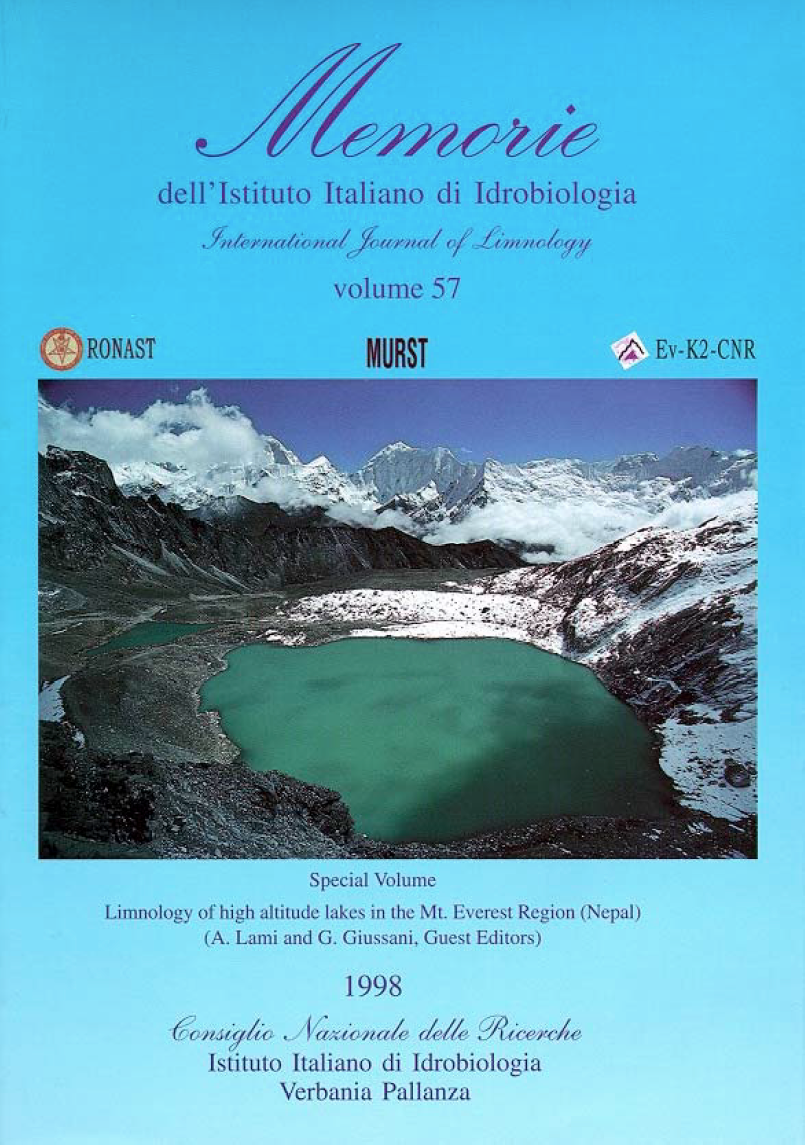
Limnology of high altitude lakes in the Mt. Everest Region (Nepal)
Limnological research carried out jointly by Nepal and Italian scientists under auspicious of RONAST/Ev-K2-CNR Project following the establishment of “Piramid Laboratory” in 1990 in Lobuche at a height of 5050 m at the foot of Mount Everest, one the highest inhabited places in the world, marks a major contribution in the field of limnological research in Nepal.
The aim of this book is, instead, to collect in an integrated database all the currently available information on the limnology of high-altitude freshwater lakes. This will be the first time it has been attempted to produce such a large database on these remote lakes, which lie at an altitude of about 4000-6000 m a.s.l. In fact, 69 of the 90 lakes mapped in the area of the Mt Everest Region have been sampled and analysed for chemical and biological parameters, using uniform techniques. This database will contribute to filling the gaps in our present knowledge and furthering our understanding of human impact in remote areas
|
|
Citation proposal
. Limnology of high altitude lakes in the Mt. Everest Region (Nepal). https://geoportal.mountaingenius.org/geonetwork/srv/api/records/d99fd5e0-7498-4c7c-a7c3-202006020973 |
Simple
- Date ( Creation )
- 2014-05-05
- Edition
- Purpose
- Status
- On going
Originator
- Maintenance and update frequency
- As needed
- Keywords ( Theme )
-
- SHARE
- Keywords ( Place )
-
- Nepal
- Keywords ( Place )
-
- Mt. Everest
- Keywords ( Theme )
-
- lakes
- Keywords ( Discipline )
-
- limnology
- Access constraints
- Copyright
- Use constraints
- otherRestictions
- Other constraints
- Spatial representation type
- Text, table
- Metadata language
- English
- Character set
- UTF8
- Topic category
-
- Boundaries
))
- Supplemental Information
- You can customize the template to suit your needs. You can add and remove fields and fill out default information (e.g. contact details). Fields you can not change in the default view may be accessible in the more comprehensive (and more complex) advanced view. You can even use the XML editor to create custom structures, but they have to be validated by the system, so know what you do :-)
- Reference system identifier
- WGS 1984
- Protocol
- WWW:LINK-1.0-http--link
- Name
- Description
- OnLine resource
- Mem_57.pdf
- Protocol
- OGC:WMS-1.1.1-http-get-map
- Name
- Description
- Hierarchy level
- Dataset
- Statement
gmd:MD_Metadata
- File identifier
- d99fd5e0-7498-4c7c-a7c3-202006020973 XML
- Metadata language
- English
- Character set
- UTF8
- Date stamp
- 2019-12-04T19:16:11
- Metadata standard name
- ISO 19115:2003/19139
- Metadata standard version
- 1.0
Point of contact
Overviews
Provided by